Quick Facts
- Credits: 33
- Delivery: On-Campus
Build the technical and research skills to measure, model, and improve human movement. Ball State’s 33-credit MS in Exercise Science with a concentration in Biomechanics combines advanced coursework with hands-on work in 3-D motion capture, force measurement, electromyography, gait analysis, and movement modeling.
Work closely with faculty on clinically relevant, sport-performance, and industry-focused research while preparing for doctoral study or careers in motion analysis, rehabilitation, ergonomics, human performance, and related fields.
What You Will Learn
Ball State’s master’s program in biomechanics equips
you to thrive in diverse clinical, research, and educational settings by
combining dynamic coursework with hands-on experiential learning. Guided by
expert faculty, you’ll benefit from access to our state-of-the-art biomechanics
laboratory and a collaborative environment that fosters innovation and lifelong
professional connections, setting our graduates apart as leaders in the field.
- By graduation, you will be able to:
- Collect and interpret 3-D motion-capture, force, and electromyographic data
- Apply mechanical and musculoskeletal principles to questions in health, rehabilitation, sport, and human performance.
- Design and carry out a biomechanics research study, from hypothesis development through data analysis and presentation.
- Critically evaluate biomechanics literature and translate findings for scientific, clinical, coaching, or industry audiences.
- Build professional experience through laboratory research, thesis work, and collaborative projects.
What It’s Like to Pursue a Master’s Degree in Biomechanics at Ball State
Learn by working with the tools used to study movement.
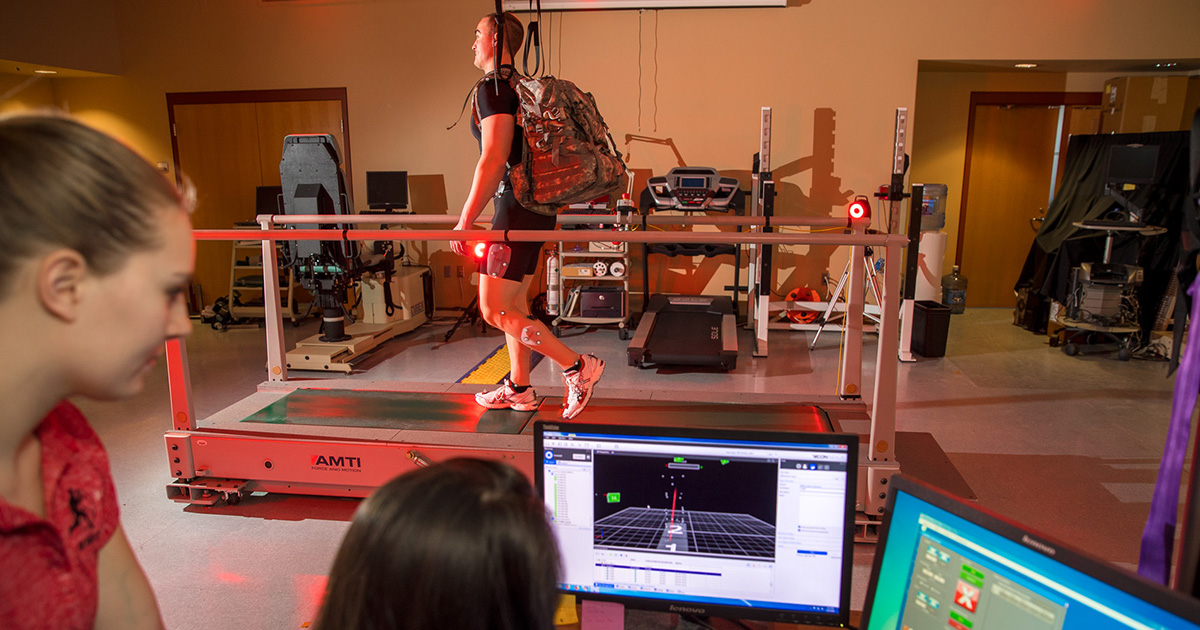
Students gain experience in a biomechanics laboratory equipped for 3-D motion analysis, electromyography, force measurement, locomotion research, and movement simulation. Depending on their research involvement, students may contribute to study design, participant testing, data processing, interpretation, and dissemination of findings.
- 28 high-speed cameras to conduct 3-D motion analysis
- hard-wired, telemetry, and indwelling electromyography
- a split-belt force instrumented treadmill to measure forces during locomotion
- computer simulation and modeling of movements
- 8-camera markerless motion capture system, and
- 6 AMTI force platforms and a force-instrumented posture and balance platform
Learn More
Put your education to practice through hands-on research in a variety of clinical rehabilitation and sport performance settings.
Our clinical-based biomechanics research focuses on gait and posture analysis in numerous populations, including neurotypical individuals as well as those with cerebral palsy, Parkinson’s disease, stroke, and impairments common to older adults.
Past projects have assessed bone and muscular changes in healthy young adults and the elderly, orthopedic knee replacements, and the muscular mechanics of injury.
Sports biomechanics research focuses on the effects of fatigue on performance across a wide number of movement skills.
In addition to neuromuscular research, our laboratory has also engaged in the development and validation of equipment and technologies for various companies.
Graduates in biomechanics are successful at being accepted into doctoral programs or finding careers in their area of study.
Our graduates have also been employed in premiere clinical facilities and with industry leading companies manufacturing biomechanical and fitness equipment.
- Have a broad understanding of the scope of biomechanics and its applications.
- Demonstrate proficiency in the use and application of biomechanical research tools and techniques.
- Have the ability to synthesize research findings in the field of biomechanics and apply the research process to effectively test hypotheses.
- Be able to clearly summarize and communicate findings from research literature in both an oral and written fashion.
A master’s degree in biomechanics will move you along the path toward doctoral study or a career in clinical, industrial, or academic settings.
Potential pathways after graduation
- Clinical
and movement-analysis settings: motion analysis technician, gait
laboratory coordinator/manager, rehabilitation research coordinator,
clinical research specialist.
- Sport
and human-performance settings: performance analyst, sports-science
research assistant, strength-and-conditioning research support, technology
or wearable-data specialist.
- Industry
and product development: ergonomics specialist, biomechanics test
engineer or technician, product-validation specialist, footwear or
equipment research associate.
- Further
education: doctoral study in biomechanics, kinesiology, rehabilitation
science, biomedical engineering, or related disciplines; professional
preparation in fields that require separate credentials.
Specific job eligibility depends on prior training, experience, employer requirements, and any required licensure or additional education
Program Requirements
Our program offers both thesis and non-thesis master’s degree options, allowing you to tailor your studies to your career goals. Required courses provide a strong foundation for research and laboratory work in exercise science and biomechanics, covering essential lab techniques and statistical methods critical to the field.
You’ll further your education through courses in clinical and advanced biomechanics, exercise science and physiology, and resistance training. If you choose the thesis option, you’ll complete a six-credit research project under the guidance of your graduate advisor, gaining valuable experience in conducting and presenting original research and preparing yourself for additional graduate education programs.
Funding Your Graduate Studies
Keep Exploring
Take the Next Step
If you’d like to learn more about our Master's in Biomechanics degree, complete our online form or contact us for more information. And if you’re ready to apply, review our admission requirements and complete our online application.