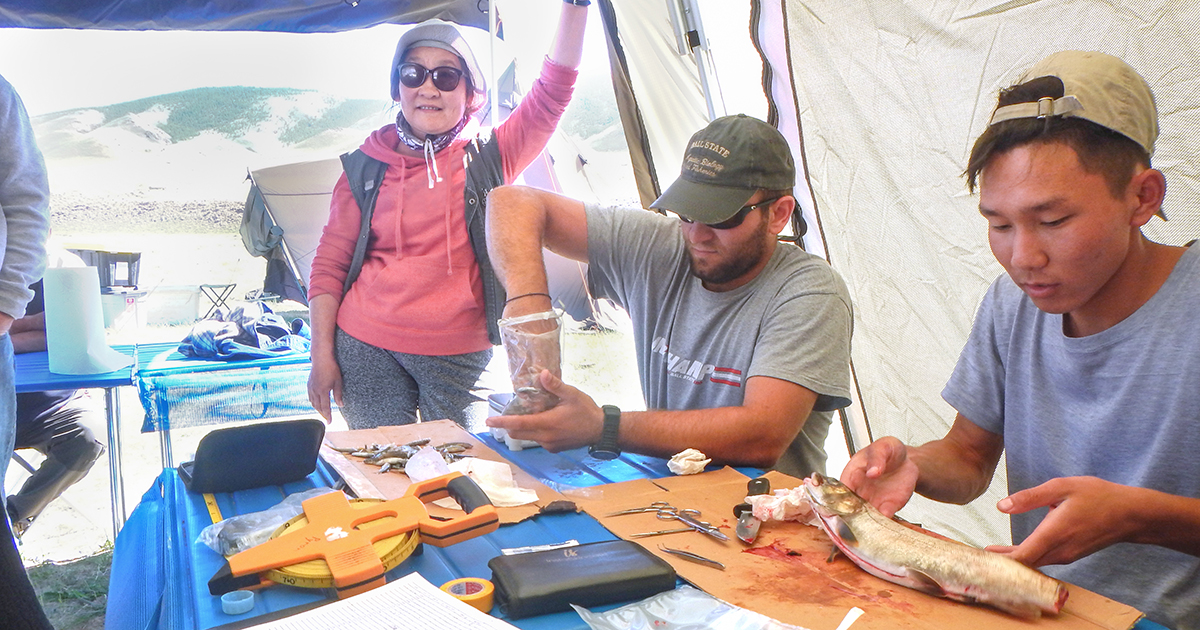
As a student pursuing a PhD in environmental sciences at Ball State University, you will conduct interdisciplinary research in a wide variety of topics with concentrations in biology, chemistry, geography, geological sciences, or natural resources and environmental management. You will address complex environmental problems by integrating multiple approaches into field and laboratory studies to address complex factors impacting the earth’s environment.
Our PhD in environmental sciences program gives you a well-rounded background necessary to meet the needs of numerous career opportunities in post-secondary education, government agencies, the private sector, and nonprofit organizations. You will develop the skills necessary to pursue complex questions in environmental science using an interdisciplinary approach.
Why Ball State?
A unique feature of this program is an interdisciplinary focus. Your program originates in a major discipline that you will complete with coursework from other scientific disciplines. Ultimately, your program culminates in a dissertation that draws from more than one discipline.
Each student participates in an interdisciplinary research colloquium every semester in residence and will have the opportunity to present their research at several of these colloquia.
You will take classes with faculty in our departments of:
You will develop as a scholar and fully understand interdisciplinary research's advantages by participating in our faculty mentorship program.
When you apply, we ask that you identify a faculty mentor who will chair your PhD committee.
You will choose from approximately 30 affiliated faculty members across five departments. These faculty members have established research in the environmental sciences and have embraced our interdisciplinary approach.
Read about Our Faculty
You will practice scientific research methods in a concentrated field, develop an understanding of the importance of an interdisciplinary approach to the environmental sciences, practice scientific communication through presentations and publications, and develop an ethical approach to scientific inquiry.
As part of your professional development, you'll participate in a teaching internship (SCI 790). This involves a supervised and mentored experience in the instruction of a science course or labs.
We also host a weekly research colloquium featuring presentations by students, faculty, and guests, who discuss their research within the environmental sciences. You will sign up for the colloquium (ID 605) each semester of your residency. These presentations are free and open to the public.
Program Requirements
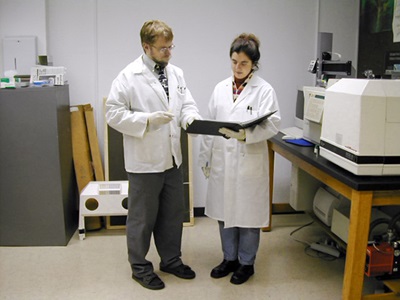 The PhD in environmental sciences is primarily a research degree and is conferred, in part, in recognition of research accomplishments.
You must:
- complete an approved program of coursework
- pass the comprehensive examinations
- write an acceptable research proposal and petition for admission to candidacy
- complete a program of significant original research
- defend the dissertation research
We expect you to publish a major portion of your dissertation in a refereed national or international journals.
Students who complete this program are able to:
- demonstrate skills necessary to pursue complex questions in the Environmental Sciences
- produce a dissertation that draws from more than one discipline
- orally present one’s own research
- teach post-secondary education in the Environmental Sciences
- conduct scientific research in public and private sectors
Concentrations
You'll choose a concentration from one of the following departments:
To see the full list of courses and requirements for the degree, visit the course catalog.
Course Catalog
Paying for Your Education
A graduate assistantship is an excellent opportunity to gain meaningful professional experience working alongside experience, expert faculty while helping cover the costs of your education. Learn more.
Ready to Apply?
In order for us to consider you for admission to this program, you must have the minimum of a master's degree in biology, chemistry, geography (meteorology, remote sensing, GIS), geological sciences, natural resources, environmental science, or an equivalent science program at an accredited institution, plus meet the minimum standards required for admission by the Graduate School.
Apply to the Program
More Information
If you would like to learn more about the doctoral program in environmental sciences or about the Ball State University Graduate School, please complete our online form to request more information. Or if you’d like to speak directly with someone in our department by phone or email, please contact us.